Anderson bats for regional security, defence cooperation
Loading article...
-
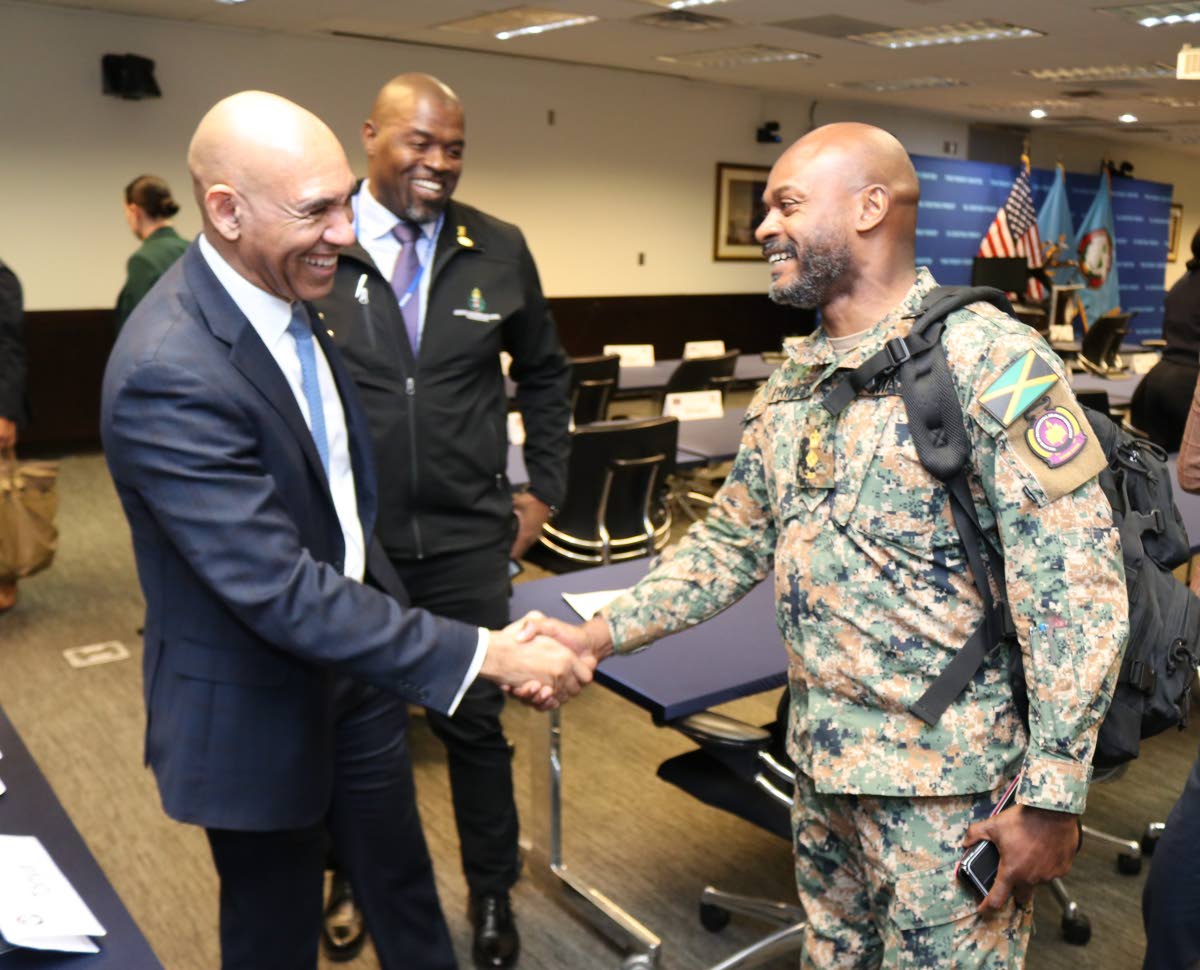 Major General (Ret’d) Antony Anderson (left), Jamaica’s ambassador to the United States and permanent representative of Jamaica to the Organization of American States, greets Jamaica Defence Force Lieutenant Colonel Zavian Phipps (right), a participant in a two-week Caribbean security and defence course at the William J. Perry Center for Hemispheric Defense Studies at the National Defense University, Fort McNair in Washington D.C. on March 17, while Atlee Rodney, executive director of Regional Security System, looks on.
-
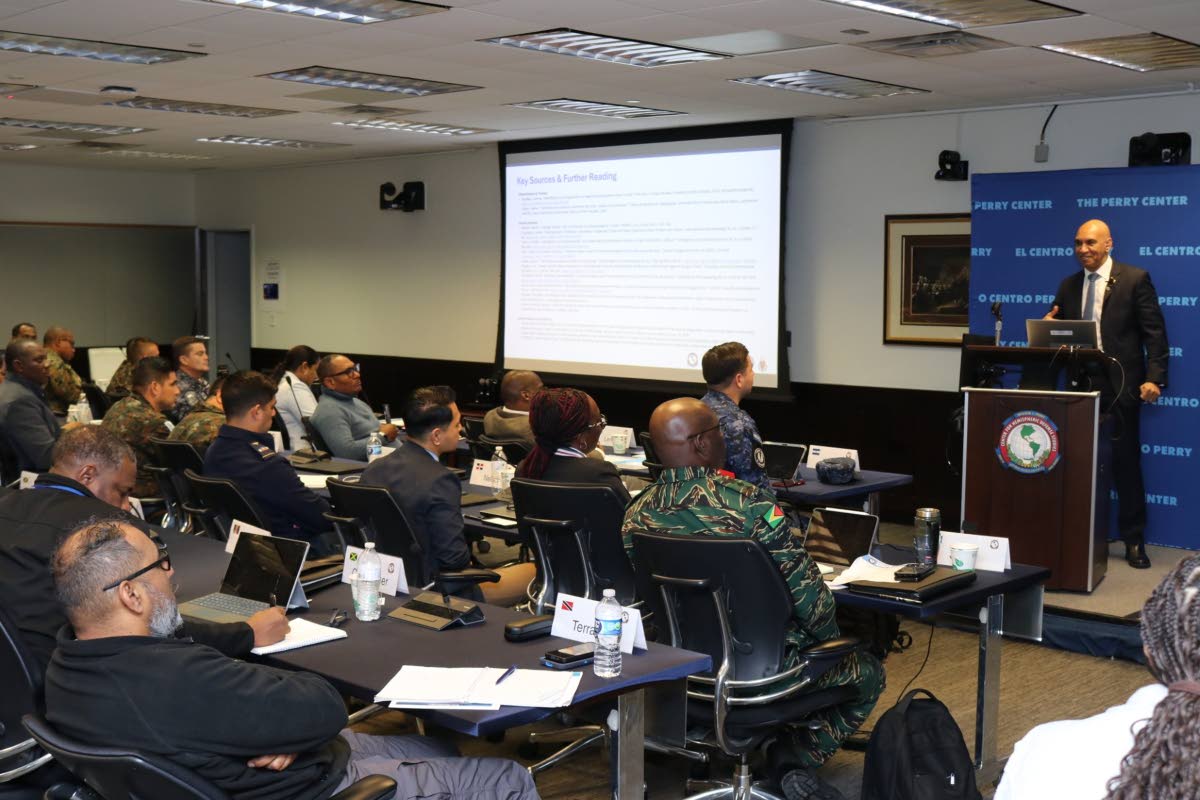 Major General (Ret’d) Antony Anderson (right), Jamaica’s ambassador to the United States and permanent representative of Jamaica to the Organization of American States, addresses participants of a two-week Caribbean security and defence course at the William J. Perry Center for Hemispheric Defense Studies at the National Defense University, Fort McNair in Washington DC on March 17.
Jamaica’s Ambassador to the United States, Major General (Ret’d) Antony Anderson, last Tuesday reinforced a commitment to the Caribbean’s regional defence and security cooperation, as he addressed defence and security professionals from 16 nations at the William J. Perry Center for Hemispheric Defense Studies, National Defense University, Fort McNair, Washington DC.
Anderson, who also serves as Jamaica’s permanent representative to the Organization of American States (OAS), was the featured speaker before an audience of faculty professors and 52 senior defence and security professionals, including a delegation of eight high-ranking officers from the Jamaica Constabulary Force and Jamaica Defence Force. In commending the work of the Perry Center, Anderson underscored its role in facilitating knowledge exchanges as he outlined the importance of alignment and policy understanding across all levels of government.
“The Perry Center provides a platform for professionals normally involved in the execution of strategies and plans that deliver key outcomes, to also develop an understanding of the policy requirements and policy context of your respective governments, as you advance throughout your careers,” stated Anderson.
“At this level, it is important that while you execute, there is an understanding of the policy framework that drives those operational plans and activities, particularly in the complex, fluid and high-threat environments within which you operate, where there is a persistent need to make critical decisions with significant strategic consequences, the ambassador continued.
Leadership insights
Drawing on his distinguished career as Jamaica’s former national security adviser, former commissioner of police, and retired chief of defence staff, Anderson offered substantive leadership insights grounded in direct operational experience.
“As you advance in your careers and as leaders, you will engage more and more with the political class and across multiple sectors. You will be key actors of the all-of-government approaches adopted across our region. As such, you must be able to articulate and execute the policy intent of your organisations, as you navigate the evolving security environment, which demands more than ever, cooperation, dynamism and adaptability,” Anderson said.
He referenced in particular his role as regional commander for CARICOM Forces in 2007, where he saw to the mobilisation of one of the Caribbean’s earliest multinational forces for a mega event – a landmark deployment spanning multiple countries that demonstrated the region’s capacity for integrated security cooperation when guided by clear command structures and shared political will.
“Mobilising a Cricket World Cup multinational force across 15 countries speaking five different languages into a coherent force that could collaborate and cooperate during the planning and execution processes required early and sustained engagement at the political and operational levels to foster shared understanding and support. ”
Anderson emphasised that the strength of the professional relationships developed through the Perry Center course – which brings together senior security practitioners from across the hemisphere – represents essential capital for the Caribbean’s future security posture.
The two-week Caribbean Security and Defense Course drew 52 participants representing Belize, Brazil, the Dominican Republic, El Salvador, Grenada, Guatemala, Guyana, Haiti, Jamaica, St Kitts and Nevis, St Lucia, St Vincent and the Grenadines, Suriname, Trinidad and Tobago, and the United States, as well as representatives from the CARICOM Implementation Agency for Crime and Security and the Regional Security System. The course concluded with a graduation ceremony at the Perry Center yesterday.