Basil Jarrett | What future are we schooling our children for?
Loading article...
-
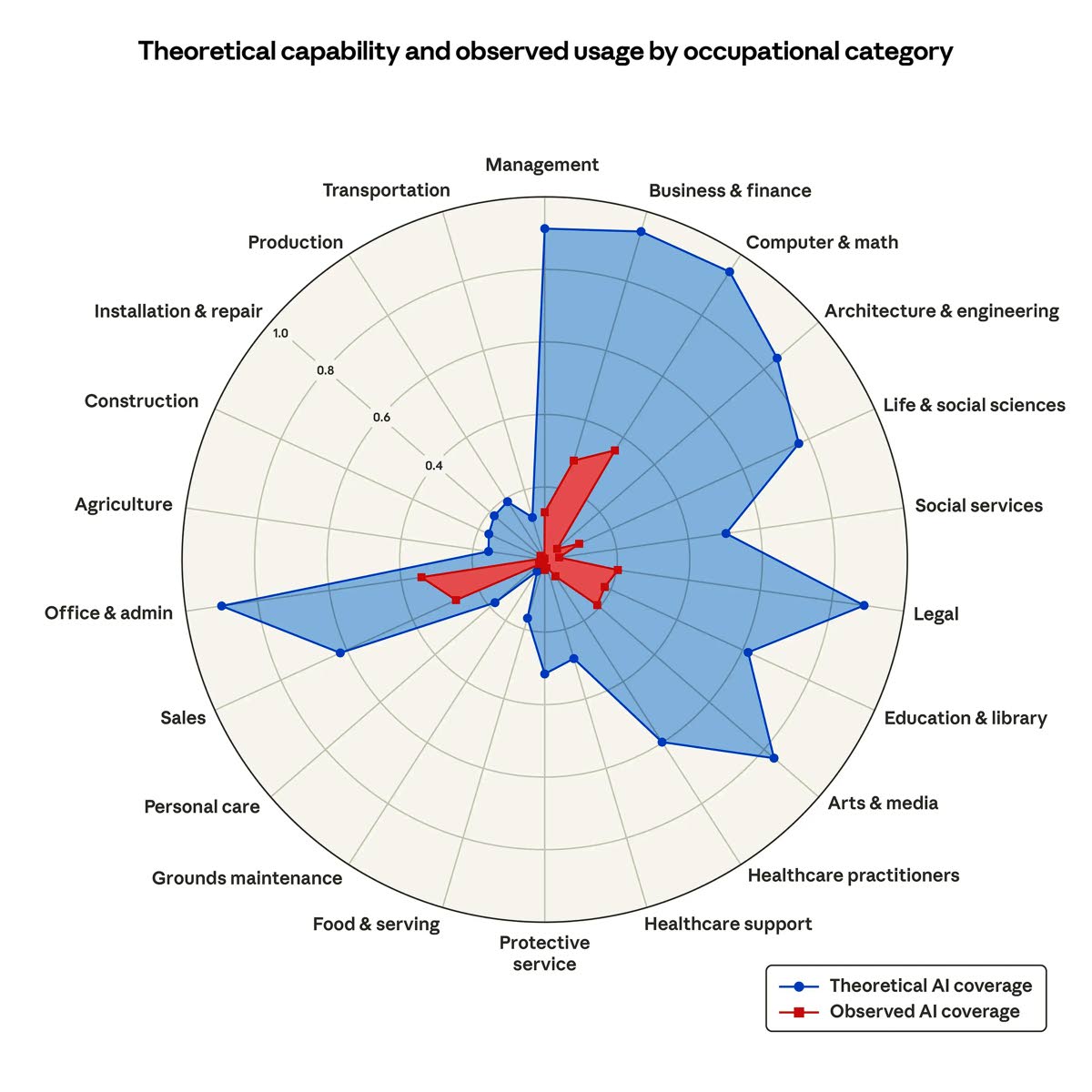 Anthropic diagram
-

It’s a thought that should frighten every parent in 2026: The fact that their child is excelling in exactly the kind of work that a machine is learning to do faster, cheaper and without needing a lunch break.
That, in essence, is the uncomfortable reality of AI lab Anthropic’s recent report on the theoretical and observed impact of AI on the labour market in 2026. Anthropic, makers of ChatGPT competitor Claude AI, released the report two weeks ago, suggesting that the jobs that are theoretically more exposed and vulnerable to AI displacement are already showing signs of being replaced in real-world observations, and that ,over the next several years, the pressure will show up as weaker hiring, especially for younger people trying to enter those fields. It suggests too that the disruption from AI is more likely to build gradually than hit all at once, with higher-paid, more educated, white-collar roles, you know, the type of work that we encourage our children to pursue, facing more risk over time.
A GLIMPSE OF THE FUTURE
At first glance, Anthropic’s model looks like one of those diagrams designed by a bored economist with too much time and too many crayons in his hand. But, stare at it long enough and the message becomes clear: the jobs with the highest theoretical AI coverage, management, business and finance, computer and math, architecture and engineering, legal, arts and media, office and admin, and chunks of education and healthcare support, are precisely the kinds of jobs many of us have spent years telling our children to chase.
Go to school, we tell them. Pass your exams. Get a good office job. Become a lawyer, accountant, manager, media professional, engineer, because those are the crown jewel careers. That message may now very well be, “Study hard, darling, so one day an AI chatbot can do 90 per cent of your work before lunch time.” That is the scary future hiding behind this model.
The reason it feels so unsettling is that it flips our old assumptions upside down. For generations, we told children that the escape route from hardship was clear: move away from manual labour and into clean, professional, knowledge-based work. Get away from the shovel, the wrench, the farm, the hairnet, the broom, the welding torch. Get into the office. Get behind the computer. Wear long sleeves and send emails with ‘Kind regards’ at the bottom.
AT RISK JOBS
But this chart suggests that the very jobs we associated with security and upward mobility are now the ones standing closest to the AI firing squad. Look at the blue spikes. Business and finance. Computer and math. Legal. Arts and media. Office and admin. Management. These are not fringe jobs. These are the respectable jobs that make parents smile at church or post on Facebook. The jobs that justify school fees and student loans and a framed graduation photo over the living room settee. And yet, according to this model, they are among the most exposed to AI.
And that is where every education minister, principal, guidance counsellor and parent in Jamaica should sit up and ask “what exactly are we preparing our children for”? What we perhaps need now is a second look at, not just technical skill, but the kind of human capability that machines still struggle to replicate well. Judgement, empathy, courage, ethical reasoning, complex problem framing, leadership and the ability to work across disciplines.
In plain English, we probably need to stop educating children merely to pass exams and start educating them to be commercially useful humans, whatever that looks like.
RETHINKING WORK
This means rethinking what we value. Maybe the child who is good with his hands, who can repair things, improvise, diagnose a practical problem and solve it in the real world, is not “less bright” than the one who writes a polished five-paragraph essay or gets 10 CSEC subjects. Maybe the little girl who can organise and inspire people, calm conflict, care for the elderly, and build trust in a team, is more future-proofed than we realise.
Because the great irony in this chart is that some of the lower-exposure jobs are the very ones we have taught our children to look down on. Installation and repair. Construction. Grounds maintenance. Food service. Personal care. Agriculture. These jobs are harder to automate, not because they are simple, but because the real world is messy and doesn’t respond to ones and zeros. It moves unpredictably, breaks unexpectedly, and starts fights without considering the full consequence.
Yes, an AI-driven robot may draft your contract before lunch, but good luck getting it to install a tarpaulin over a leaking roof in Westmoreland. And no, this is not a call to abandon university, become a plumber and start raising goats as a side hustle. But the situation calls for honesty and acceptance that the world as we know it no longer exists and the so-called “good jobs” are about to be radically restructured and, in some cases, made extinct altogether.
If we don’t adapt our education system quickly, we will be producing young people who are bright, certified, ambitious, and sadly unprepared for the new world that is rushing toward them. So, what should we do instead?
Teach children how AI works, yes, but also where it fails. Teach them media literacy so they can spot nonsense before it ruins their minds or somebody else’s reputation. Teach them ethics because, if machines are going to help make decisions, humans had better get a lot better at deciding what is fair. Teach them entrepreneurship, communication, teamwork and real-world problem-solving. Teach them that there is no honest job that is shameful, and that curiosity, adaptability and initiative are going to be genuine currency in this brave new world.
That is the only way out of this mess that we’ve wandered into.
Major Basil Jarrett is the director of communications at the Major Organised Crime and Anti-Corruption Agency (MOCA) and crisis communications consultant. Follow him on Twitter, Instagram, Threads @IamBasilJarrett and linkedin.com/in/basiljarrett. Send feedback to columns@gleanerjm.com.