Earth Today | Fires driving air quality crisis
Loading article...
-
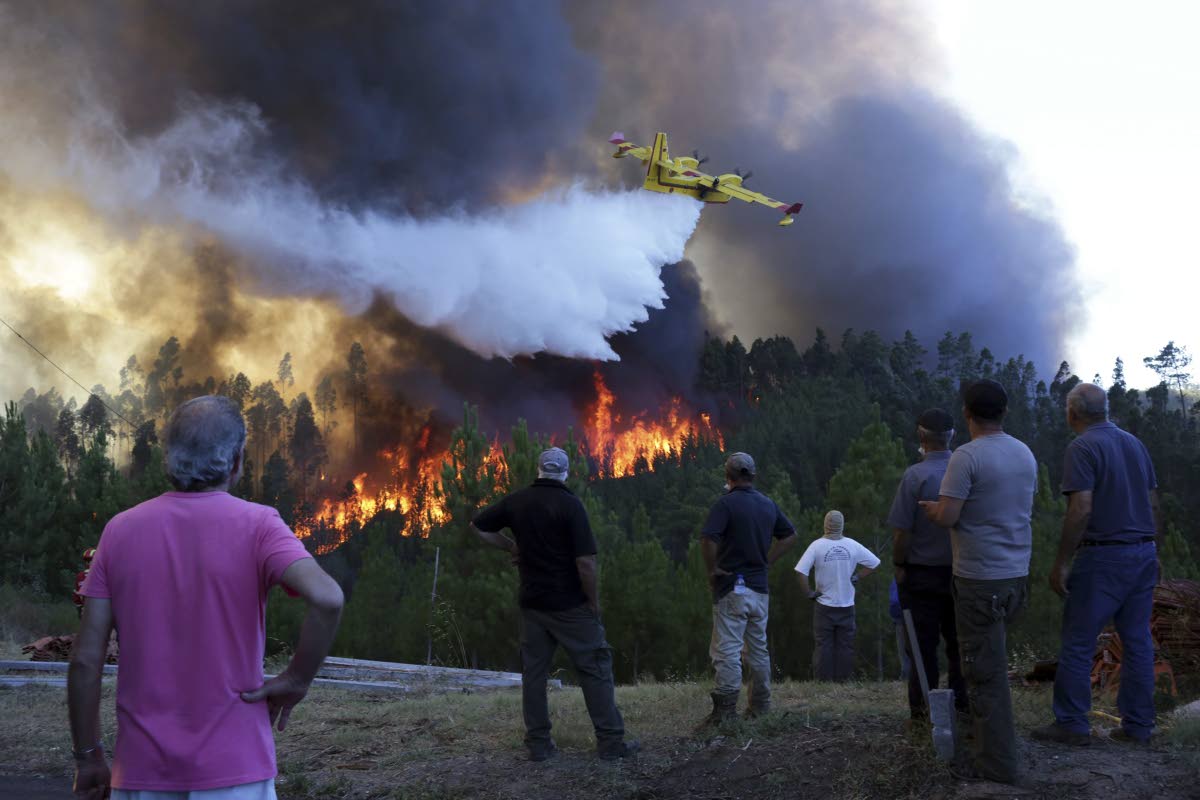 Villagers watch a firefighting plane drop water to stop a raging forest fire reaching their houses in Portugal.
-
AT A time of prevailing concerns over air quality and public health, a recent publication of the World Meteorological Organisation (WMO) has warned of the dangers of fire as a significant source of air pollution.
“Fire remains a significant and persistent contributor to particulate pollution, a factor which is expected to continue and even increase as the climate warms in coming years,” reads an article from the 2025 Air Quality and Climate Bulletin, a publication of the WMO.
“In addition to the destructive impacts of fire on infrastructure and ecosystems, there is also the air quality impacts on human health to contend with, and a rise in adverse health outcomes will likely be seen in coming years,” added the article, which looks at global particulate matter concentrations in 2024 as recorded by three products and which is authored by Johannes Flemming, Allison Collow, Mikhail Sofiev and Peter Colarco.
In ambient air, particulate matter 2.5 (PM2.5), it said, is “a severe health hazard”.
“Anthropogenic and natural sources contribute to PM2.5 pollution in varying proportions at the global scale. Emissions of PM2.5 originate from human activities such as transport, industry and agriculture, as well as from natural sources such as wildfires and wind-blown desert dust,” it explained.
In 2021, some 709,000 deaths in children under five years old were linked to air pollution. More than 200,000 of those deaths were linked to PM2.5, according to the 2024 State of Global Air Report, published collaboratively by the Health Effects Institute and the Institute for Health Metrics and Evaluation’s Global Burden of Disease project.
Of note is that the risks to children’s health begin even before birth, with exposure to air pollution while in the womb said to increase the likelihood that a baby will be born either too early or too small.
“These conditions, in turn, make babies more susceptible to lower respiratory and other serious infections, diarrhoeal diseases, brain damage and inflammation, blood disorders, and jaundice,” the Health Effects Institute report noted.
“If the babies survive infancy, they remain at a higher risk for lower respiratory infections, other infectious diseases, and major chronic diseases throughout life. Exposure to air pollution during pregnancy has also been linked to miscarriage, stillbirths, and congenital disorders and anomalies,” it added.
Meanwhile, air pollution contributed to some 8.1 million deaths worldwide in 2021 and was the second leading risk factor for death among children under 5, after malnutrition.
“Most people on Earth are exposed to unhealthy levels of air pollution. Each year, millions of people die early, and many more live with debilitating chronic diseases because of breathing polluted air. The threat of air pollution is not new, but it is changing. Air pollution has contributed to death and disease and has hurt economic prospects and community resilience for decades,” the State of Global Air Report said.
“During that time, policies and technologies have succeeded in drastically improving air quality in some areas, saving lives, and proving that pollution is not an inevitable byproduct of economic development. Yet despite this encouraging progress, the threats posed by air pollution have continued to mount as they merge with the threats posed by global climate change and increasingly ageing populations,” it warned.
pwr.gleaner@gmail.com