Christopher Burgess | Rebuild housing in western Jamaica
Loading article...
-
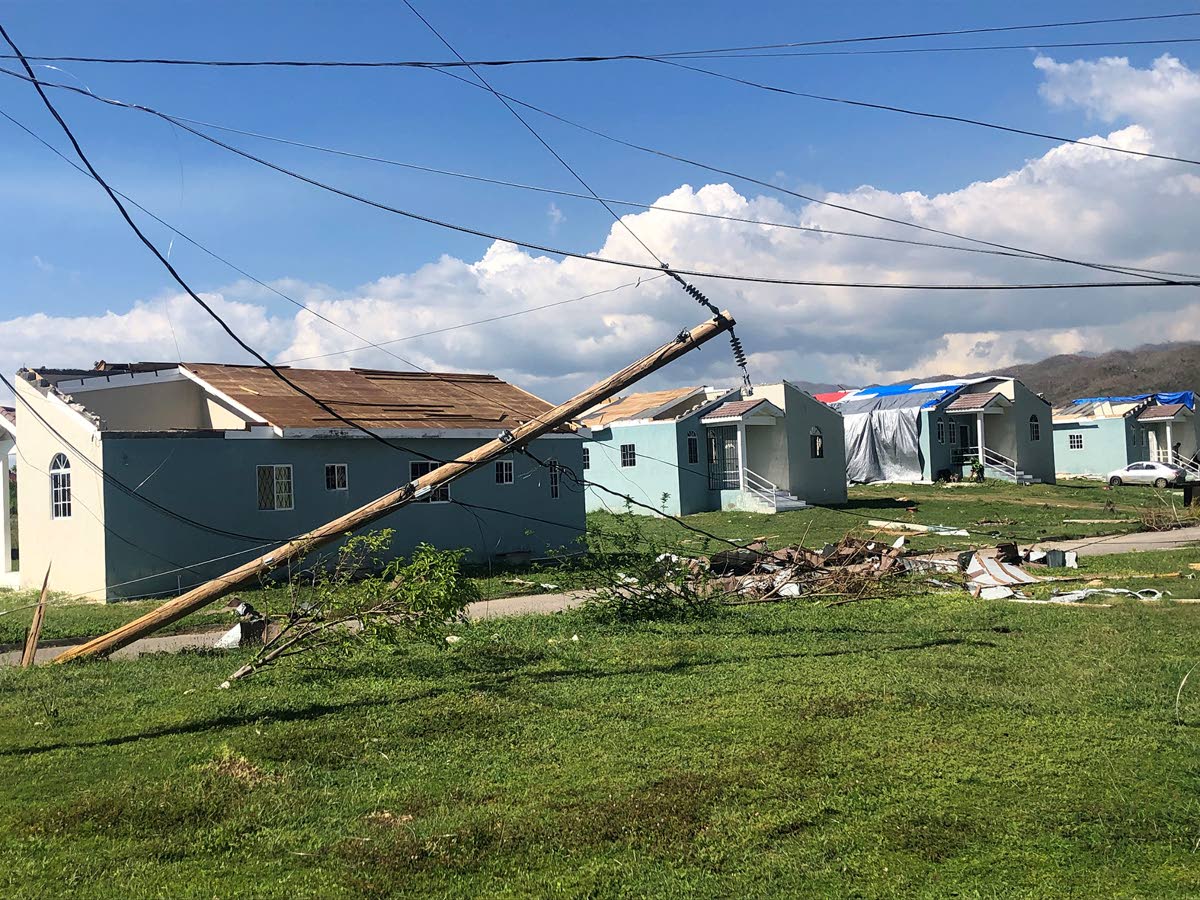 Houses in the Brompton Manor development destroyed by Hurricane Melissa.
-

Christopher Burgess
Almost six weeks ago, Hurricane Melissa devastated western Jamaica and exposed long-standing inequalities. It damaged 190,000 homes and hit the most vulnerable — families in board houses on leased and captured land — the hardest.
As recovery begins, we must avoid rebuilding the same weaknesses. With thousands still living under tarpaulins, in cars, or in damaged houses, Jamaica faces a narrow window to prevent long-term suffering. International standards are clear: vulnerable families must transition quickly from emergency to permanent housing, or they will rebuild with unsafe, weak materials. Jamaica’s proven path is durable block-and-steel construction, just as Sir Alexander Bustamante did in the aftermath of Hurricane Charlie. We now have a once-in-a-generation chance to rebuild with true resilience.
SPEED IS SAFETY
From all indications the bulk of the foldable container housing the government plans to order, will not arrive before February 2026. That will be five long months after Melissa. Disaster recovery benchmarks from the UN, Red Cross, and FEMA call for affected persons to be placed in temporary transitional housing within three months, and in permanent housing within 12–24 months. Temporary structures deteriorate quickly and, after a year, trap families in fragile conditions that deepen long-term poverty.
Rapid transition to durable homes is essential to prevent repeating the same devastation. Families who remain too long in damaged or makeshift housing inevitably rebuild with light timber, battered zinc sheeting, and tarpaulin, locking in new vulnerabilities. The only way to break this cycle is to move people swiftly into resilient and permanent housing. Government must act faster than vulnerability can rebuild.
LESSONS FROM LOUISIANA
Louisiana’s long hurricane history shows that temporary disaster housing often creates lasting problems. After Hurricane Katrina in 2005, tens of thousands of FEMA trailers and container-type units arrived late, required concrete pads, and deteriorated quickly in the tropical climate. Many developed mould, leaks, and toxic fumes—triggering national lawsuits. Trailer parks became semi-permanent “disaster villages,” difficult to remove and prone to crime and blight.
These shelters never solved the housing shortage. Families — especially renters and African Americans, much like board-house renters in Westmoreland—fell deeper into poverty because permanent rebuilding was delayed. Louisiana now prioritizes rapid permanent housing and “shelter-in-place repairs” instead of container schemes. Similar concerns across the Eastern Caribbean and Asia have led governments to restrict fragile container housing. Advisers should test units carefully, read beyond manufacturers’ brochures and consult UN and ODPEM experts before buying more units. As my Granny would say: “fisherman sell fish.”
FROM BOARD HOUSES TO BLOCK AND STEEL
Melissa struck those living in Jamaica’s most fragile housing—board structures on family land, leased land, and informal settlements. The Shelter Sector Working Group estimates that 31,000 houses were severely damaged in Westmoreland and Hanover, with roughly 20,000 likely being board houses, reflecting long-standing land-tenure patterns rooted in post-emancipation history and the old sugar belt. Generations of land-ownership barriers, tenancy, informal “capturing” and affordability issues have produced widespread board-house settlements.
These houses persist because they are the only option many families can afford. Before the hurricane this year a local carpenter noted that a 12×24 ft board house sells for about J$470,000 and a larger two-bedroom for around $1 million. By contrast, a basic masonry home starts at over J$3 million—well beyond reach for low-income families. Without land-tenure reform and subsidized permanent housing, this cycle will continue.
Resilience cannot be divorced from land tenure and regularization. In southern Westmoreland, large government-owned sugar lands, each—40 to 300 acres—remain prime for regularization or planned housing, while hilly northern family lands that continue to lack titling, as each generation, takes a small piece of land for themselves to build their own board-house. These structures are often the only housing many families can afford, in comparison to sturdy masonry homes. Government must be willing to improve tenure through regularisation programme like LAMP and Operation Pride, which despite this government’s veneration, still operates under the Housing Agency of Jamaica.
A masonry smart-building kit for a 400 square feet home — 1,200 blocks, five tons of steel, 200 bags of cement, plywood, and 50 yards of sand and gravel—costs under J$1.9 million and is bigger, stronger, and faster than any foldable and temporary plastic container unit. With construction drawings from UTech, and proper guidance from HEART, and financing from NHT, families can self-build safely. For roughly US$350 million, Jamaica could end the cycle of vulnerability in the west and create a national model for resilience and stimulate the local economy.
One size does not fit all. Prefabricated homes, “cube” units, poured-concrete shells, and engineered timber houses are also viable permanent options. Jamaica’s contractors and developers could produce more than 80 of these per day using local labour and materials. A combined self-build and prefabricated strategy could finally eliminate the board-house problem in western Jamaica.
DECK IT AND FORGET IT
Private and public housing schemes performed far better than self-built homes during Melissa. Thousands of scheme units withstood Cat-4 and Cat-5 winds thanks to strong framing, anchoring, and fastening—proving that Jamaican developers can build robust timber roofs.
Concrete slab (decking) roofs also performed well. While some leaked, they kept families safe, and many became shelter for neighbours who lost their roofs. Slab roofs require stronger walls and foundations, but for one- and two-storey homes they remain an excellent option. Government should support assessments and construction of slab roofs for households that choose decking during rebuilding.
BUSTA THE BUILDER
Bustamante and the colonial government understood this. After Hurricane Charlie destroyed over 9,000 board and “nog” houses in 1951, they launched a Hurricane Housing Programme and hired Marley & Plant Construction firm. USAID in their study of hurricane resistant housing in Jamaica said
“cement block construction was adopted by the colonial government as the primary method of constructing low-income housing. With heavy government emphasis on block”
This marked Jamaica’s first shift toward hurricane-resilient block-and-steel homes. Today, more than 75 per cent of our housing stock is block-and-steel—a testament to the government of Sir Alexander.
Smart recovery must combine land-tenure regularization with a house starter kit to move families into permanent, climate-resilient homes. Rebuilding must focus on three imperatives: act quickly to avoid entrenching vulnerability, address land tenure so families can invest safely, and transition the vulnerable to permanent concrete or block-and-steel housing, just as Jamaica did after 1951.
Jamaica does not need to repeat Louisiana’s mistakes with fragile temporary housing. We have the talent, materials, and expertise to rebuild stronger homes and safer communities—for the next generation.
Christopher Burgess, PhD, is a civil engineer, land developer, climate change scientist and the Managing Director of CEAC Solutions. Send feedback to columns@gleanerjm.com.