Sculpting ‘One Love’
Loading article...
-
 Reggae Marathon’s famous Bob and Rita Marley trophies sculpted by Basil Watson.
-
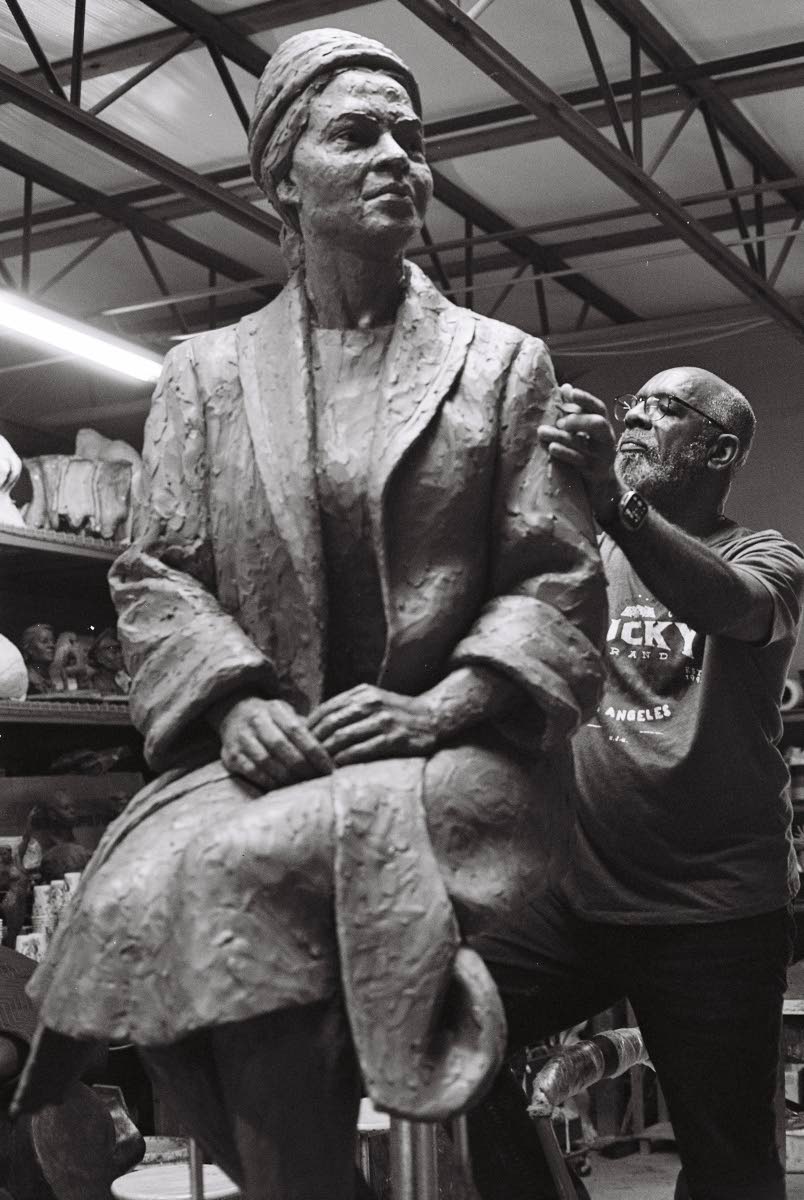 Contributed photos
Sculptor Basil Watson carves a sculpture of Rosa Parks for the Equal Justice Initiative in Montgomery, Alabama.
Contributed photos
Sculptor Basil Watson carves a sculpture of Rosa Parks for the Equal Justice Initiative in Montgomery, Alabama.
When runners cross the finish line at the Reggae Half Marathon race today (December 7), they are not just pursuing a cause, striving to achieve personal bests or reaching for a medal. They are aiming for a piece of Jamaican art, a symbol of culture, endurance, and unity, created by one of the country’s most celebrated sculptors: Basil Watson.
For more than two decades, Watson has crafted the famous pair of Reggae Marathon Bob and Rita Marley trophies. Awarded to the male and female winners of the Half Marathon, the trophies translate the spirit of Jamaica’s music and people into sculptural form that reflects the event’s message of One Love, inspired by the legacy of reggae icon Bob Marley.
Watson’s partnership with the Reggae Marathon began at the event’s inception. “I was living in Jamaica at the time when I was approached by the organisers to create the trophies for the inaugural marathon event in 2001,” he reminisced. Even after relocating abroad, Watson continued designing the pair of Bob and Rita Marley trophies for each year.
The Bob and Rita Marley trophies are deeply symbolic. For Bob Marley, Watson wanted to portray Bob as the Messenger, standing high on a multi-tiered base representing the Rock, spreading his message through music, voice, and guitar. For Rita, he envisioned arms open, welcoming and embracing, symbolising the couple’s message of One Love, with a base shaped like a heart. “For both trophies, I used photos and my general knowledge and impressions. I also contacted Rita’s management for additional images as this was before the widespread use of Google,” he explained.
Watson’s creative process of the trophies is an intentional blend of traditional techniques with careful attention to symbolism. The original sculptures were modelled in clay, and a rubber mould was created to produce fibreglass replicas each year. The choice of materials and techniques was guided by durability and the repetitive nature of trophies, while his modelling technique allowed for an accurate physical representation of both figures. He emphasises that he does not think about imposing his own artistic voice. “I just do. I am a figurative artist, and using the skills I have acquired, I seek to express the idea and trust that it will be heard,” he explained.
The trophies carry a message that extends beyond music. “Reggae Marathon represents sport, health, exercise, culture, and people coming together. It is inclusive and diverse, which is the message of Bob Marley,” Watson shared. His long-standing involvement has allowed him to see firsthand the impact the trophies have on participants and the wider community. Participants have expressed deep appreciation for the trophies. “I’ve received messages from winners saying the trophies are the highlight of their experience. One female repeat winner even told me she has earned several of the Rita trophies over the years, but has never won a Bob, and she regrets not being able to complete the pair for her collection.”
Even in the face of hardships in the aftermath of Hurricane Melissa, Watson sees the trophies and the Reggae Marathon as symbols of resilience. “The trophies are replicas each year, but this long-distance race represents perseverance and endurance. The fact that the race continues, despite challenges, shows that Jamaicans will overcome and that we will demonstrate the qualities symbolised by the event,” he explained.
Watson, who now lives overseas, continues to draw inspiration from and pay homage to Jamaica. “Moving to the United States has afforded me the opportunity to grow on an international level and take my work to higher heights,” he said.